For the Nigerian woman who always starts strong but quits somewhere along the way...
Nothing is wrong with you. Your diets keep failing in the same place, and nobody has told you why.
No calorie counting. No gym membership. No new recipe every morning. Food from your own market. And not one day of going hungry.
₦19,500₦9,800
Get The One Pot Method — ₦9,800
- Secure checkout
- Instant download
- Discreet billing
It's Monday, and you've decided. Maybe you told your sister, or the family WhatsApp group. This isn't your first plan; it might be your fourth.
The first week, you're perfect. You drink water in the morning, no puff-puff at the office. You cut your Eba in half and tell yourself that half is enough...even though we both know, deep down, that you're not quite satisfied yet.
You cook one pot for the family, then a separate small thing for yourself, from a diet plan you downloaded from the internet -- full of recipes you've never cooked before. By Day 9, after a full day's work, you're tired of cooking twice and deciding what the next thing should be, so it quietly stops.
In the second week you step on the scale, expecting a reward. It hasn't moved, and some days it has even gone up. Come on!
In the third week, it's eleven o'clock at night and the house is asleep. You're in the kitchen eating the bread you bought for the children's breakfast, and you don't stop until it's gone.
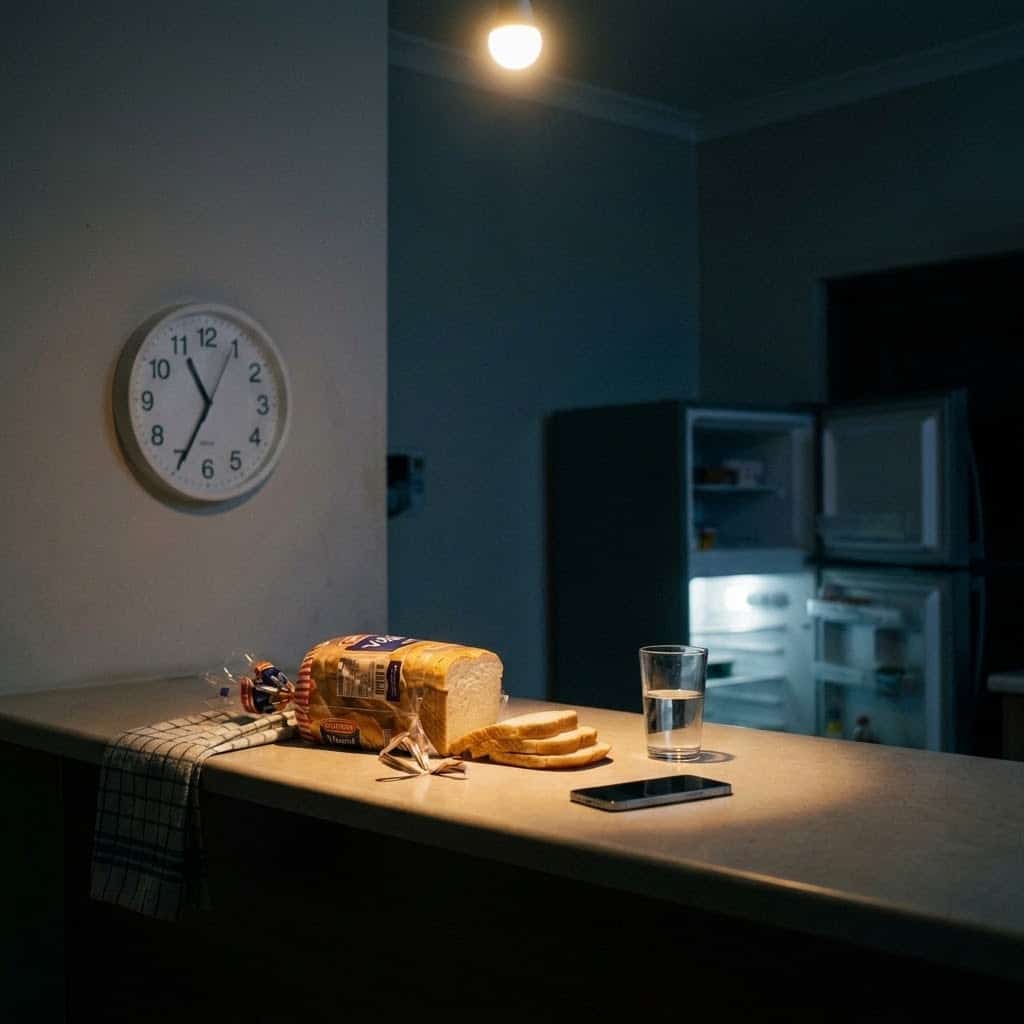
In the morning you hate yourself a little. You don't announce that it's over. You just go quiet, and you're grateful when nobody asks.
There's a slimming tea in the cupboard and a gym card you used twice. There's still a meal plan on your phone that opened with oats, salmon and Greek yoghurt, and you closed it, because where? With what money, and in whose kitchen?
You're not lazy. Lazy women don't hold down a job and run a home. So, privately, you've started to believe something worse: that something is wrong with you, something other women don't have.
Nothing is wrong with you. But something is wrong with every plan you've tried, and it fails in the same place every time.
I've worked as a gym trainer and fitness instructor, and I've lost the same 13kg three times on my own body. Let me show you where it fails.
Here's what nobody told you
Your diets didn't fail because you lack discipline. They failed around the two-week mark, for four reasons nobody ever sat you down and explained.
Once you see them, the last few years will start to make sense.
It's the food, not the amount.
Swallow, bread and white rice break down fast in the body; And so a few hours later, you're hungry again, hungry enough to eat 4-6 times a day. Fried food carries oil you never see.
So every diet built on eating less of these foods becomes a fight with hunger. You can win that fight for a week. Somewhere in week two or three, hunger wins. You can't cheat nature.
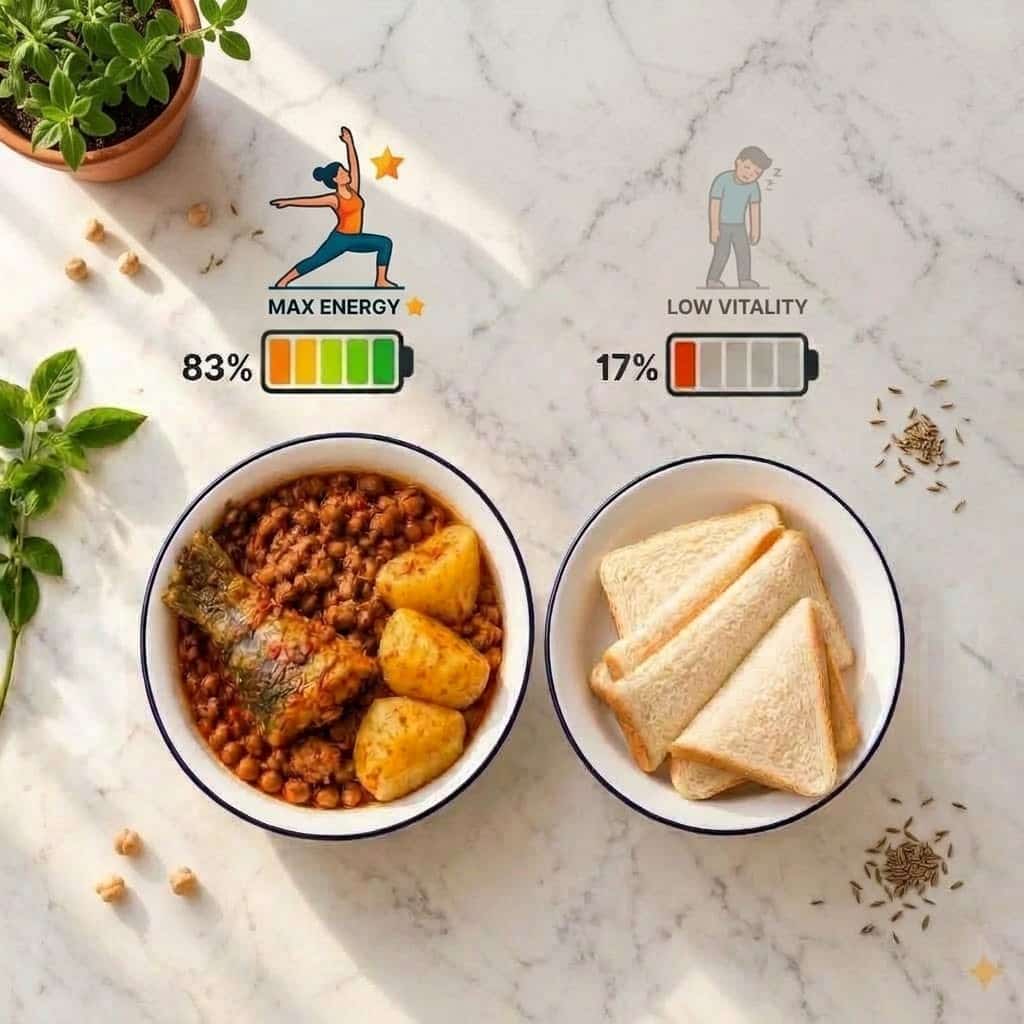
Food that still looks like where it came from is different: Beans, Fish, Irish Potatoes, whole fruit (like Water-melon, Oranges, Apples, Avocado, e.t.c), vegetables. They hold you for hours. You can eat them until you're full, and naturally won't get hungry easily. This means that your portion sizes basically take care of themselves, without you thinking about it or needing to measure anything.
You don't have to take my word for it. In 1995, researchers at the University of Sydney fed volunteers 38 everyday foods, each portion carrying exactly the same calories. Then they measured how full each food kept them.
Boiled potato came first, more than three times as filling as white bread. Fish came second. Oranges, apples and beans sat near the top, and croissants, cake and doughnuts came last.
Same calories. Three times the fullness. That's why this plan never asks you to be hungry. Sustained hunger or intermittent fasting is not a long-term strategy you can practically sustain for any significant length of time.
Home-cooked is not the same as weight-loss friendly.
Egusi soup and fufu is home-cooked. It's natural, and nothing in it came out of a factory. It's also one of the heaviest meals in the Nigerian kitchen.
You may have spent years eating food you believed was healthy and wondering why nothing moved. I wondered too. I'll tell you about it in a minute.
The scale lies in the first two weeks.
The weight you measure on the bathroom scale fluctuates a lot during the first 14 days. Water and whatever is still in your stomach show up as weight. If your period is close, it can add about half a kilo of water, sometimes more, on the very day you weigh.
You read that fluctuation as failure, and doubt begins to creep in. So when the cravings arrive around week three, there's no belief left to maintain the discipline you had when you started the weight-loss journey.
You blamed the cravings. But it was the scale that shook your conviction first.
You didn't fail the food. You failed the decisions.
What to eat this morning. Which recipe. Which shop sells Kiwi or {insert random unfamiliar fruit you saw in the online diet plan you downloaded}. Whether this counts. Whether that is allowed. So many decisions...
Every plan you've tried before caused you to make thirty separate decisions every month, on top of the hundred you already make for everyone else. Nobody keeps that up for twelve weeks.
This plan has one pot, and if your family wants it, that same pot feeds everyone at your table. Cook it once at the weekend, and there's nothing you need to decide on a Tuesday morning.
The part nobody says out loud
No food burns fat. Not beans, not greens, not any tea in a sachet. Yes, I said it, but hear me out. Everything you eat adds something to your body; there is no food in this world that takes anything away.
The fat that you burn is the fat that was already in you. Your body reaches for that store when it needs energy and less of it is coming in.
So nothing here burns anything for you. What happens is that the diet itself does not further add to the weight that is already present, because food that holds you for hours is hard to overeat. The energy spent during a 30-minute morning walk spends a little more of that fat, and that's how your weight continues to go down.
It was never the food itself. It's what the food is carrying, and how long it holds you after eating.
If anyone sells you a food or a drink that 'melts' fat, they're selling you a story.
The whole method, in one line
Eat food that still looks like where it came from.
When you're not sure about a food, ask three questions:
Would it go bad if left out for a day?
Was anything that naturally comes with it taken out in a processing factory?
Will it still be holding you in 4 - 6 hours after eating it?
That's the method. What I haven't told you yet is how I found it, or why a man is the one writing to you about it.
I found this by accident. I was broke.
Before I tell you what happened, you should know who is writing to you.
I'm a Nigerian man in my early thirties, and I work on a laptop most of the day. You won't find my name or my face anywhere on this page, and that's deliberate.
This isn't about me. The method doesn't need my face to work. It needs your pot.
I've trained in the gym since 2013. When I started this journey, I couldn't jog for even five minutes, and a single pull-up was a struggle.
Today I can run at 10km/h for thirty minutes straight and crank out fifteen to twenty pull-ups. No supplements, not one tub. Nobody handed me that; it was years of showing up.
I've also worked as a gym trainer and fitness instructor. I've been the beginner who couldn't manage one pull-up, and I've also been the one running the workout session. I've been on both sides. I've been where you are now.
I'm telling you this so one thing is clear from the start: discipline was never what I was missing, because the weight still found me. Three times.
The broke years
Years ago, I had very little money. So I ate almost nothing but Beans.
Not because a doctor told me to, and not because I'd read about it somewhere. When you can only afford to fill your stomach one way, you choose the food that stays there longest. For me, that was beans.
I got lean and athletic because I was still working out at home during that period (I couldn't afford a gym membership at the time). I got lean enough that I could see veins in my lower abdomen, below my navel.
Back then, I didn't really make the connection between my specific single diet and my weight loss. I was too busy being broke to ask why. I just assumed it was the morning jogging alone.
When life got easier
Then money got better and life got easier. My eating drifted, the way eating does when you're no longer counting every naira. A bit more variety was introduced to my diet. A little more of everything I couldn't afford before.
The weight came slowly enough that I didn't notice, and fast enough that one day I did. And one day, I checked the scale boom! I weighed around 88kg, up from maybe 74kg.
So I did what most of us do. I tried harder at the wrong things.
Everything that didn't work
The workouts alone didn't stop it. I was already training, and I still put on weight anyway. Fitness and weight are two different projects, it turns out.
You can build a body that runs and still carry weight you don't want.
Jogging alone didn't fix it. At my worst, I was jogging 5km every single day. Not when I felt like it. Every day, except Sundays.
"Home-cooked" didn't save me either. While I was running those 5km, I was eating egusi and fufu.
It's the kind of meal that makes you feel you've eaten properly. Nobody looks at a plate of egusi and fufu and thinks "junk." I most certainly didn't.
I remember what I told myself, because it sounded so reasonable: "This is home-cooked, not processed, so I'm fine."
I wasn't fine. I stayed exactly the same, day after day of 5km runs, week after week.
If you've ever done everything right and watched nothing move, you know the kind of tired I mean. It was frustrating. It isn't in your legs. It's in the part of you that believed effort pays.
That's what that season of my life really cost me: trust in my own effort.
I'd assumed the answer was more: more running, more sweat, more discipline. It never occurred to me that the most important decision of my day was being made at the pot, not on the road.
Home-cooked tells you where the food was made. It tells you nothing about what the food does once it's inside you.
The question I should have asked years earlier
The turning point wasn't dramatic. It was a question.
"How did I lose so much weight back when beans were all I could afford?"
I mean, I had been running 5km a day and staying exactly the same. Years before, eating the one food I could afford, I'd been lean enough to see veins below my navel.
The answer had been sitting in my own history the whole time. I had mentally filed it under "the broke years" and never looked at it again.
So I went back to the beans.
And the weight came off. Effortlessly. Melted like butter.
Here's what I understand now that I didn't then. The beans didn't need willpower. They held me for hours, so I wasn't fighting hunger all afternoon. There was nothing to be disciplined about.
Beans, fish, potatoes, fruit: the same foods near the top of that Sydney study we referenced earlier. I'd found the first one by accident, as a result of my empty pockets.
The beans weren't burning anything, and no food does as we've established. They just stopped me piling more on top of what was already there.
Three experiments, one pot
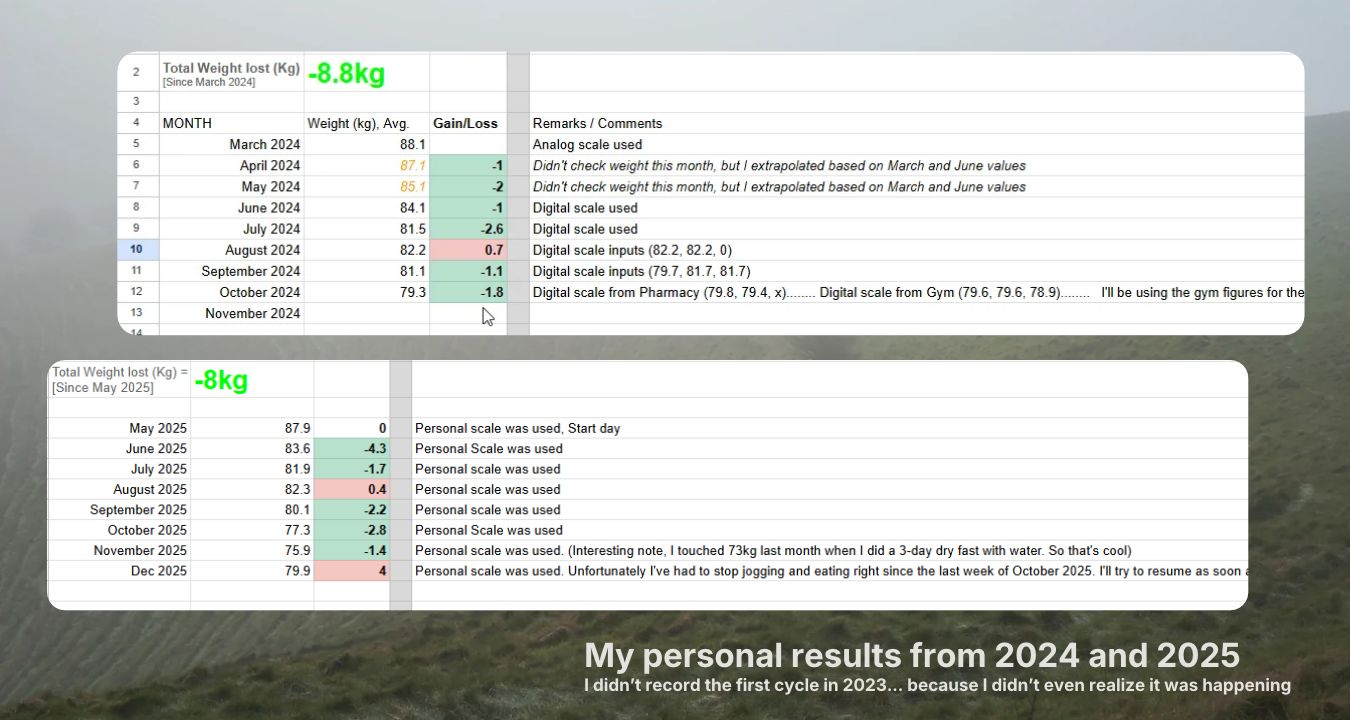
I didn't stop at beans. Over three separate weight-loss cycles of me experimenting on myself, each time dropping from around 88kg down to around 75kg, I wanted to be sure this discovery was not a fluke. So I kept refining my methods: what held me longest, what I tested and had to throw out, and what stayed.
Doing it once could have been luck. Doing it three times, and watching the weight return every time I drifted, is how I know what works for me. And because I'm an average, normal person, I'm confident my methods will work for you too if you put it into practice for at least 12 weeks.
Out of those experiments came three lists:
- What I ate and lost weight on
- What fits the guideline but I haven't tested yet
- And what I tested and failed on.
Most plans only ever show you the first list. You'll get all three, because the third one is where the honesty is.
It ended up as one pot and a short week:
A walk of at least thirty minutes, sometime between 7 and 10am in the morning. Cloudy mornings count too: because sunlight still gets through the clouds, even when the sun doesn't.
Beans with boiled or air-fried fish. (I sometimes alternated with boiled Irish potato porridge.)
Fried Greens (Aleho) or broccoli as an alternative veggie, fried in a little palm oil with onions, crayfish, pepper and a pinch of salt. Expect to want something to wash it down after the palm oil. Water often does it, and when it doesn't, any fruit you like works. An apple or an orange is my go-to.
Watermelon or any whole fruit, eaten until I'm satisfied. I like water-melon especially because its water content alone fills me up, so I'm less likely to eat again.
One planned 'cheat-meal' off the list, something to look forward to after a week of sticking to the plan (And also so I don't lose my mind haha). My choice is jollof pasta (Spaghetti or Macaroni). It isn't a slip; it's part of the method.
So yeah, that's my week. I share it as what worked for me, not as a law you have to obey.
The order isn't a rule either. If greens suit your mornings and beans suit your evenings, swap them, and if you aren't hungry for all three in a day, don't eat all three.
That's the whole point. A plan that keeps you hungry is a plan you will quit, and nobody eating real food needs to be hungry. Eat to your fill.
The Saturday cheat meal matters more than it looks. A treat you planned can't turn into a failure.
Look at what's missing from the week. There's no recipe to learn, nothing to decide in the morning, and no gym. Morning is beans, afternoon is greens, evening is fruit.
The day decides itself, and you don't even need a gym membership if you don't like it, or if you have a medical condition that prevents you from strenuous workouts.
And I mean no gym. I train because I like training, and that's me, not the method. If you have the time and the money for one, use it; if you don't, a thirty-minute walk is everything this asks of your day.
The gym is necessary for building muscle. For strictly weight loss, however, you will be just fine with a combination of a healthy diet + the daily discipline of getting your steps in.
Want faster results?
None of this is required, and you still don't need a gym. The pot and the thirty-minute walk are the baseline, and they're enough on their own. But if you have extra time, or you already have a gym and enjoy it, here's what I add when I want to go faster:
- Walk longer. Stay out in the morning sun past the thirty minutes. 10,000 steps a day is a good number to aim for.
- Add weight to the walk. If thirty minutes is all you have, wear a weighted vest or carry a weighted bag. Your body spends more energy in the same thirty minutes, and over the weeks that adds up. Start light and build up.
- Stairmaster. If you have gym access, aim for at least 1,000 steps a day.
- Skipping rope. It helps too, and you can do it at home. Start with short rounds.
Nobody ever regretted more healthy movement at a reasonable effort.
Now look at what's in the diet: beans and fish; greens fried in palm oil with onions, crayfish and pepper; watermelon in the evening; jollof pasta on Saturday. A very short list that also tastes good, and that's deliberate.
A way of eating is far easier to keep up with when you're not bracing yourself every morning for some bitter, tasteless green blend. Food you enjoy is food you'll still be eating by Week-12.
It's also why you don't have to eat separately from your family. If they want in, cook enough for the whole house.
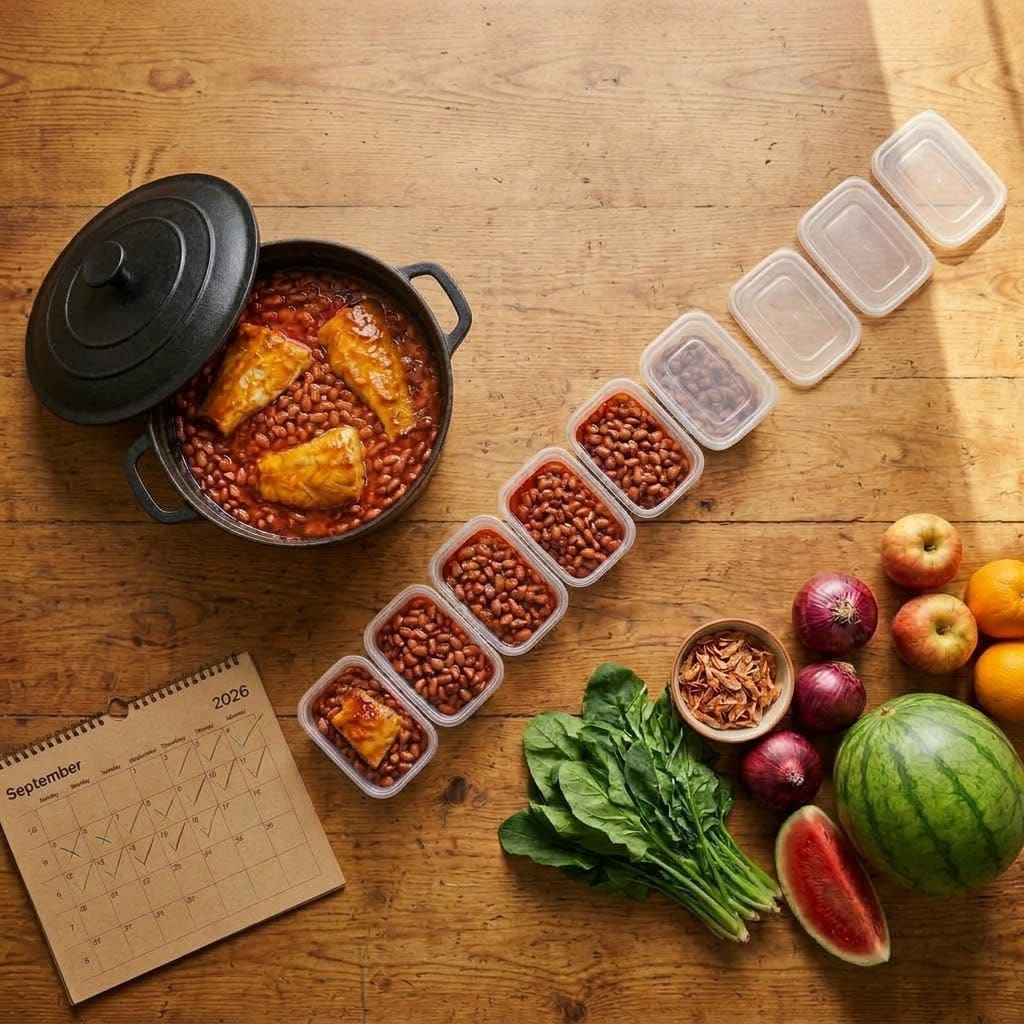
There's one more advantage to so few recipes: the pot itself can be cooked once, at the weekend. Beans or boiled Irish potato porridge, all in one pot, packed into small containers and frozen, then warmed up whenever it's time to eat.
The greens are the exception, because they are best fried fresh, and that rarely takes more than thirty minutes. So nothing else needs cooking in the middle of your workweek, and the rest of your weekend is yours to rest.
And from those runs, I boiled it all down to one line: eat food that still looks like where it came from.
The Week-2 wall
The cravings came. I won't pretend they didn't.
But here's what nobody told me, and what I'm telling you now: They don't last. If you stay disciplined past this wall, the cravings will fade.
The wall is dangerous because of its timing. It arrives just after the scale has spent two weeks being noisy, so the cravings get loud at the exact moment your belief is lowest.
For me, after around twelve weeks, my tastes had changed. Today, pizza almost irritates me.
I didn't set out to make that happen. It just did.
The pattern has held every time. When life got easier and my eating drifted, the weight came back. When I came back to this way of eating, it melted off.
Treating it like a diet was the other mistake. A diet is something you finish, and I kept finishing it.
So I've stopped calling it a diet. It's simply how I eat. My lifestyle.
Why a man is writing this for women
Now, you might be thinking: "What does a man know about my body? About a cycle that moves the scale every month? About cooking for a whole house while trying to change how I eat?"
Fair questions. Here's my honest answer.
I've never had a period, and I won't pretend to know your life from the inside. I'm also not going to hand you a man's plan and tell you to push through. Your cycle has its own guidance in the workbook, and the guarantee on this page makes room for it.
Most of what's in this workbook isn't about being a man or a woman anyway. It's about food that holds you, a scale that seems to lie to you early in the journey, and the days plans usually die.
What I do have is experience training women. It's been part of my work as a gym-trainer and fitness instructor, so I'm not guessing at who this is for.
I also have a method that worked on my own body three times, and one failure I still think about.
The spreadsheet
I once tried to help a close friend lose weight. I built her a spreadsheet to track it.
She lost 3kg in her first month, even though she was a bit on & off on the whole thing.
Then she started slipping, and I didn't have the time to walk her through it.
That's the honest version. I'd love to tell you we succeeded in her weight-loss journey. We didn't.
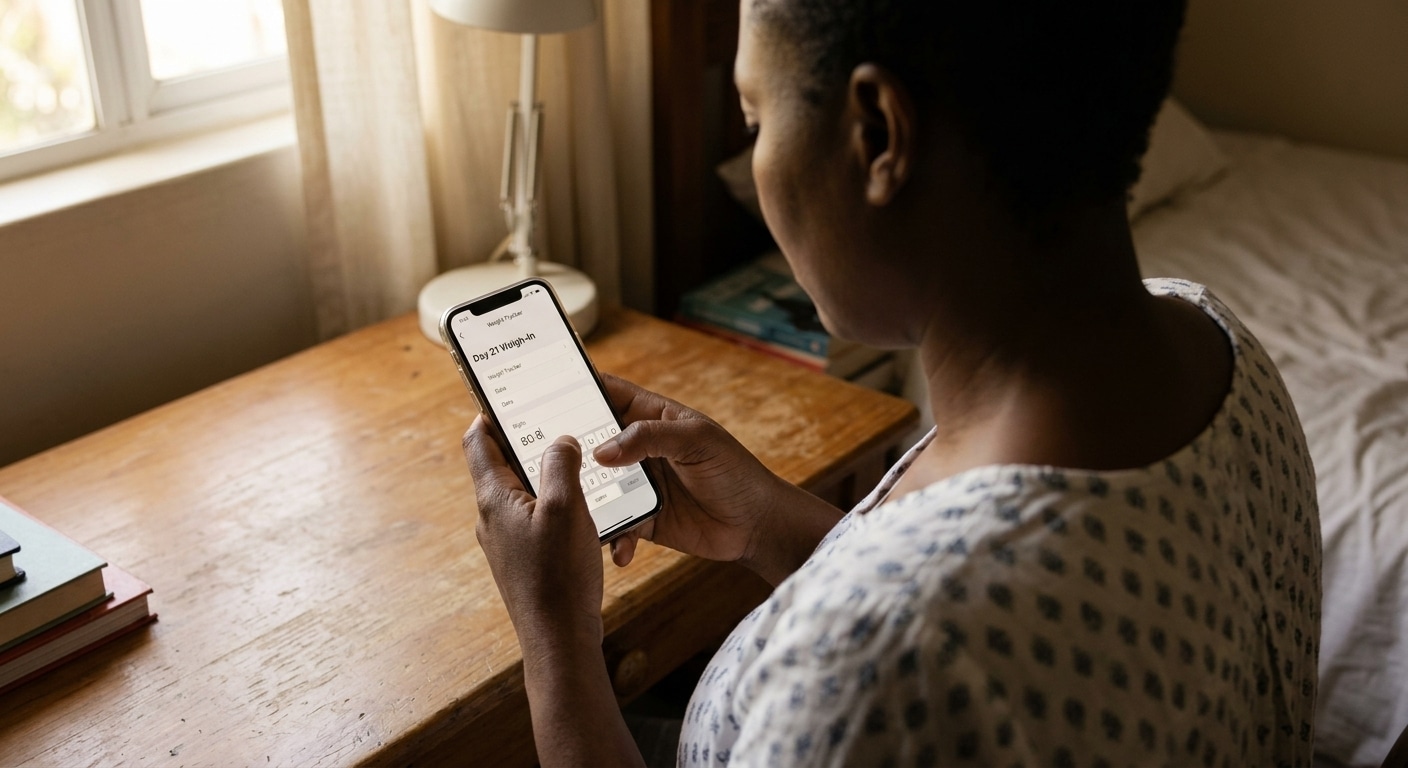
Starting was never her problem. It isn't yours either.
A spreadsheet wasn't enough. It could show her what had already happened.
It couldn't tell her what was coming: that the first two weeks are noisy on the scale, that Day 19 is where the plans usually fail due to giving in to cravings, that the cravings fade if you hold on past the 14-30 day wall.
And no spreadsheet can talk you through a hard night.
This workbook is the walk-through I couldn't give her. The pages run day by day, with the hard days marked, so you know what's coming before it arrives.
That's why it's a workbook and not a meal plan. You don't need thirty recipes. You need one pot, one page a day, and someone who has been through the wall telling you what's on the other side.
What 12 weeks looked like for me
I didn't keep a diary of every day across those three runs, so I won't invent one for you. Here's the shape it took, and the shape your workbook is built around.
- Day 1
Around 88kg. One pot of beans and one morning walk. That was the whole start.
- The first days
Beans bring gas at first, while your stomach adjusts. It's normal, it passes, and the fix for this is on page 32.
- Day 6
The first Saturday plate: jollof spaghetti, eaten without guilt, because it was planned.
- Day 14
The first two weeks are the noisiest stretch on the scale. The number on this day is information, not a verdict, which is why Day 14 has its own page.
- Day 19
The wall. This is the day plans usually fail, and the day your workbook has a page waiting for you.
- Day 23
The end of the wall. Held this long, the cravings start to fade.
- Days 30 to 60
The quiet middle. Same pot, same walk, no new decisions, and the weight kept coming off.
- Day 90
At least 10kg down, my rule of thumb from three runs that each went from around 88kg to around 75kg. My tastes had changed. Pizza almost irritates me now.
Those are my numbers, on my body, and yours will be your own. That's exactly why the guarantee on this page is built around your first 14 days, not my twelve weeks.
Where the reviews would go
This is the part of the page where you'd usually see five-star reviews and WhatsApp screenshots.
There aren't any here yet, and I won't make them up. You've seen enough of those pages on the internet to know how that goes.
The One Pot Method is new, and custom made for you. If you start now, you'll be one of the first 50 women to use it.
What I can show you is my own record, and you've just read all of it.
Three experiments on myself, going from around 88kg down to around 75kg. Training since 2013 without supplements, and working with women as a gym trainer and fitness instructor. And one failure, told to you straight.
When the first 50 reach Day 14, I'll ask each of them two things: what did the scale say, and what surprised you? With their permission, their answers go right here anonymously, in whatever mix of English and Pidgin they send them.
Until then, the guarantee is my proof. You don't pay for a result you don't get.
Your words could be the first ones on this page.
Introducing The One Pot Method
The One Pot Method: How Nigerian women lose weight within 12 weeks without ever going hungry
A 12-week workbook, not a meal plan with thirty recipes. One pot you already know how to cook, and one page a day. Make enough, and your family can eat from it too.
Busy week? Cook the pot once at the weekend and freeze it in small containers, so the greens are the only thing fried fresh on the day -- in under 30 minutes.
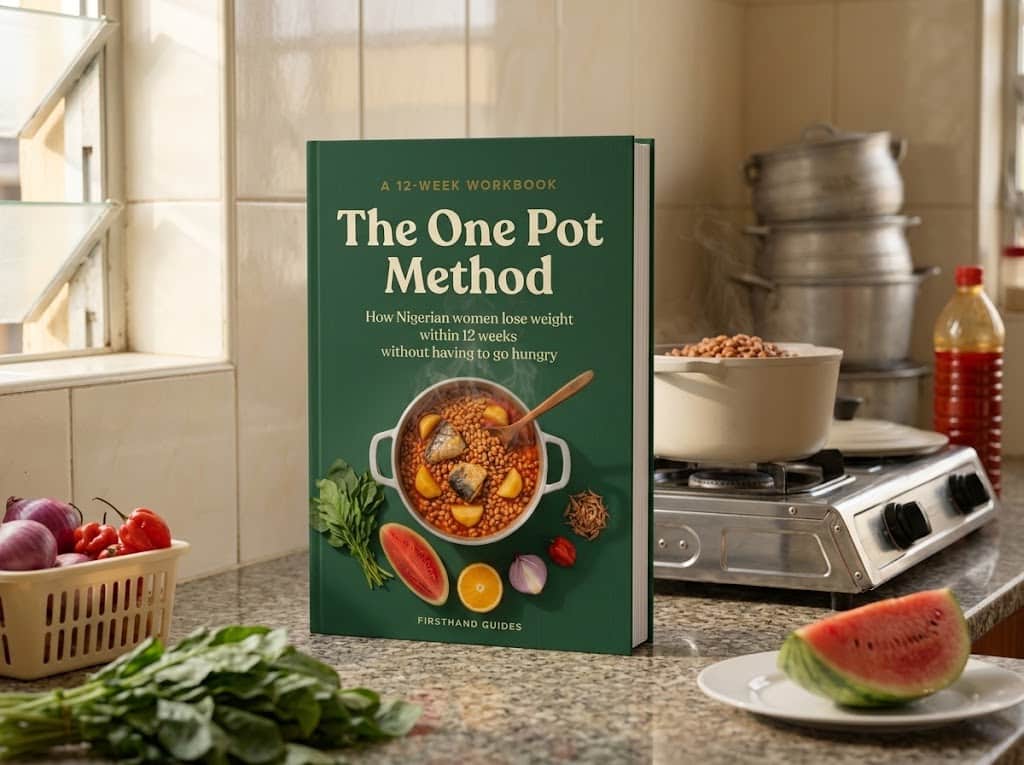
Everything in it comes from your own market, whether that's Mile 12, Wuse Market, Oil Mill or the market down your street.
Here's everything inside:
- Start HerePages 4–8
How the workbook works, and why there's only one pot.
- The Guideline and Its Three QuestionsPages 9–13
The one line that decides every plate, and the three questions that settle any food you're unsure about.
- The One Pot: My Week, Meal by MealPages 14–18
Morning, afternoon and evening, with the swaps, the water, the morning walk, the Saturday cheat meal, and why the order is yours to change.
- The Honest AllowancesPages 19–20
Why there's palm oil in the pot, and what else I still allow myself.
- The Three Honest ListsPages 21–26
What I ate and lost weight on, what fits the guideline but I haven't tested, and what I tested and failed on.
- The Market ListPages 27–29
What the week actually looks like in terms of food I personally bought from the local market.
- The Slimming Tea PagePages 30–31
The truth about the tea in your cupboard, and why no food or drink on earth burns fat.
- The Bean Gas FixPages 32–33
What to do in the first two weeks while your stomach adjusts.
- Sunday Weigh-Ins and Your CyclePages 34–36
How to weigh in each week, and how to read the number when your period is near.
- The 14-Day SprintPages 37–40
Weigh in on Day 1, follow the full checklist for two weeks (meals, water, morning walk), then weigh in on Day 14.
- The 90 Daily PagesPages 41–136
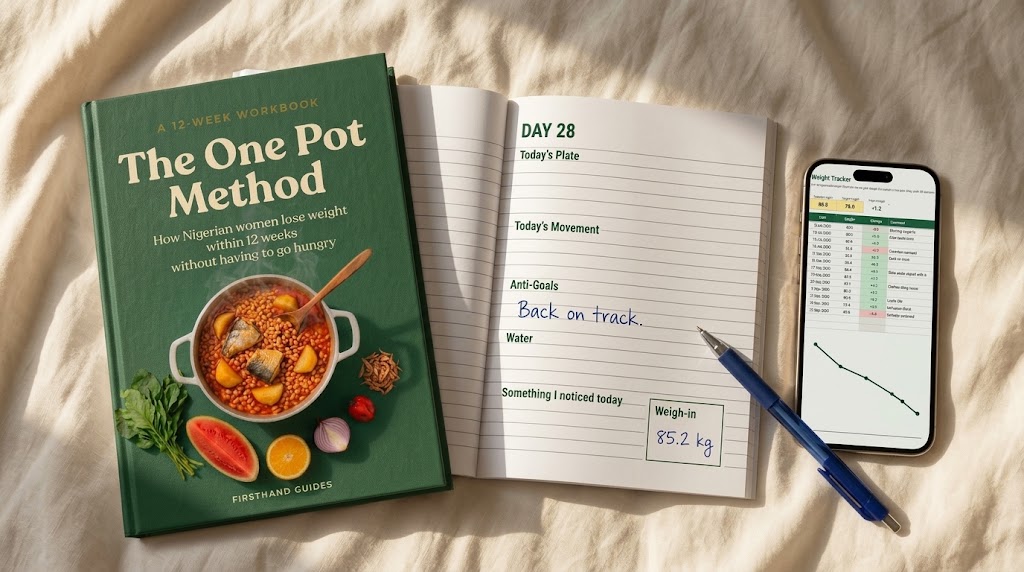
A page for every day of the twelve weeks, and six more to carry you past it, with a weigh-in box every seventh day. Each page has:
- Today's Plate
- Today's Movement
- Anti-Goals: nothing deep-fried; nothing from a packet with a long ingredient list; no swallow, bread, pasta or white rice
- Water
- One line for "something I noticed today"
- Day 14: Why the First Two Weeks Are NoisyPage 54
Read it before you step on the scale: what the number means, and what comes next.
- The Wall, Days 17–23Pages 58–66
Including page 61: "Day 19: This Is the Day Plans Usually Fail."
- Your Milestones
Day 30 (page 74), Day 60 (page 105) and Day 90 (page 136).
Nothing to count, no food to weigh, no timers, no gym. Eat until you're full.
Two bonuses, included with your copy
Bonus 1: The 12-Week Weight Tracker
Worth ₦3,500You remember the spreadsheet I built for my friend. This is that spreadsheet, 2.0, rebuilt, except this time it isn't working alone but supported alongside my years of experience with weight loss. Put your weight in whenever you like (Sunday morning is what I'd recommend), and the graph draws itself over time, so you watch twelve weeks of movement instead of trying to remember it.
Bonus 2: The Diaspora Swap Sheet — One Pot in London, Houston, Toronto and Atlanta
Worth ₦3,500Travelling, relocating, or spending a few months abroad? The plan comes with you. The swap sheet shows what to buy in London, Houston, Toronto and Atlanta: sardines, mackerel or herring in place of shawa, frozen spinach or kale in place of greens, where plain oats fit, and what the African grocery there already covers.
Here's everything you get
| The One Pot Method: the full 12-week workbook | ₦19,500 |
| Bonus 1: The 12-Week Weight Tracker | ₦3,500 |
| Bonus 2: The Diaspora Swap Sheet | ₦3,500 |
| Total value | ₦26,500 |
| Your price today |
This is the launch price, and it's for the first 50 women only. When the 50th copy sells, the workbook goes to ₦19,500.
The first 50 are the women whose Day 14 answers, with their permission, will fill that empty section above. The launch price is my thank-you for going first.
I want the One Pot Method — ₦9,800
- Secure checkout
- Instant download
- Discreet billing
The 14-Day Promise
Follow the full first 14 days: the meals, the water, the morning walk.
Weigh yourself on Day 1 and again on Day 14, under the same conditions both days: the same scale, and at the same time on both days (morning recommended), before you eat. That gives you your real day-to-day weight, not a reading thrown off by what you just ate. I highly recommend you use a digital scale.
If the scale shows less than 1kg lost, you get a full refund.
If your period falls around Day 14, your Day 21 weigh-in is the one that counts. I won't let a week of water decide this for you.
You have 45 days from purchase to claim. No proof needed, no screenshots required, no questions asked. One email to gee.connect000@gmail.com is enough.
You can also find a growing community on Facebook (The One Pot Method - Your Ultimate Weight Loss Hub) & on Instagram (@the.one.pot.method)
I set the bar at 1kg on purpose. Not 5kg, not 10kg. We're not in a rush. Everything natural. A number you can check on your own digital scale, in your own home, in two weeks. If this method doesn't clear it for you, you shouldn't pay for it.
You have two options
- Secure checkout
- Instant download
- Discreet billing
I'll see you on Day 1.
— A Nigerian man who has trained women in the gym, lost the same 13kg three times, and finally understood why it kept coming back
P.S. Remember the promise. Follow the full first 14 days, weigh in at the same time on Day 1 and Day 14, and if you haven't lost at least 1kg, one email within 45 days of buying gets you a full refund. If your period lands near Day 14, Day 21 counts instead.
P.P.S. ₦9,800 is the launch price for the first 50 women. When the 50th copy sells, it goes to ₦19,500.
P.P.P.S. You don't need another plan with thirty recipes. You need one pot per week, one page a day, and someone to tell you what's coming at Day 14 and Day 19 before you get there. I couldn't do that for my friend, but I hope I can do it for you.